
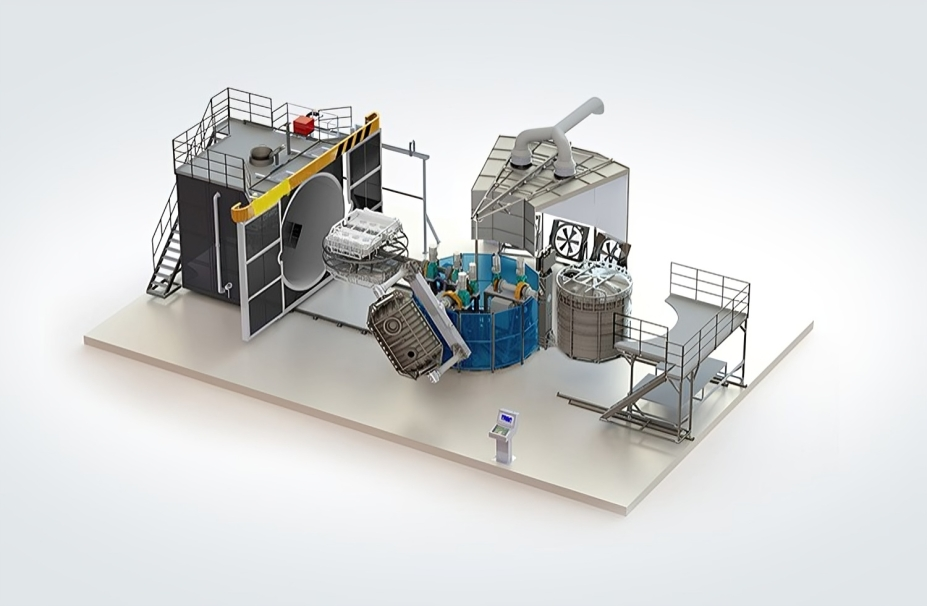
What Is Rotational Molding? Process, Advantages & Industrial Applications
Introduction
Rotational molding, commonly known as rotomolding, is a highly efficient plastic manufacturing process used to produce hollow, seamless, and durable plastic products. It is widely adopted across industries such as water storage, agriculture, infrastructure, automotive, marine, and industrial manufacturing.
Unlike other molding methods, rotational molding offers uniform wall thickness, low internal stress, and exceptional design flexibility, making it ideal for medium to large-sized hollow products.
This article explains what rotational molding is, how the rotomolding process works step by step, its key advantages, and the industrial applications that make it a preferred choice for manufacturers worldwide.
What Is Rotational Molding?
Rotational molding is a plastic molding process in which powdered polymer is placed inside a hollow mold. The mold is then heated and rotated slowly along two perpendicular axes, allowing the melted plastic to coat the interior surface evenly.
Because the process does not use pressure, the final product is:
- Stress-free
- Uniform in thickness
- Structurally strong
- Seamless
Rotational molding is especially suitable for manufacturing large hollow plastic products that require durability, impact resistance, and long service life.
How the Rotational Molding Process Works (Step-by-Step)
The rotomolding process consists of four main stages:
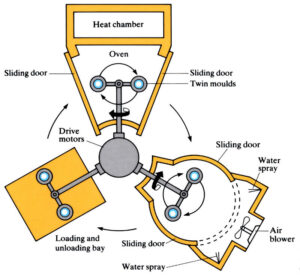
- Mold Charging
A measured quantity of plastic powder—typically polyethylene—is placed into a mold. The mold is then securely closed.
The amount of material loaded determines the wall thickness of the final product.
- Heating and Bi-Axial Rotation
The closed mold is transferred into an oven where it is heated while rotating simultaneously on two axes (bi-axial rotation).
As the temperature rises:
- The plastic powder melts
- The molten material coats the inner surface of the mold evenly
- Uniform wall thickness is achieved without pressure
- Cooling Phase
After heating, the mold is gradually cooled using air, water spray, or a combination of both—while rotation continues.
Controlled cooling:
- Prevents deformation
- Maintains dimensional accuracy
- Improves surface finish
- Demolding
Once the mold reaches the required temperature, rotation stops and the mold is opened. The finished product is removed, trimmed if required, and prepared for use or secondary operations.
Materials Used in Rotational Molding
Rotational molding primarily uses polyethylene-based materials due to their thermal stability and flow characteristics.
Common materials include:
- LLDPE (Linear Low-Density Polyethylene)
- HDPE (High-Density Polyethylene)
- MDPE (Medium-Density Polyethylene)
- Cross-Linked Polyethylene (XLPE)
These materials provide:
- High impact resistance
- UV stability
- Chemical resistance
- Long outdoor service life
Advantages of Rotational Molding
Rotational molding offers several advantages over other plastic molding processes.
✔️ Uniform Wall Thickness
The absence of pressure allows plastic to distribute evenly, eliminating weak points and ensuring consistent strength throughout the product.
✔️ No Internal Stress
Unlike injection molding, rotomolding produces stress-free parts, resulting in better durability and crack resistance.
✔️ Design Flexibility
Complex shapes, internal ribs, inserts, threads, and multi-layer structures can be easily incorporated.
✔️ Low Tooling Cost
Rotational molding molds are significantly less expensive than injection molds, making it cost-effective for medium production volumes.
✔️ Strong and Seamless Products
Finished products have no weld lines or seams, improving structural integrity and leak resistance.
✔️ Minimal Material Waste
Excess material can be recycled, making the process environmentally efficient.
Rotational Molding vs Other Plastic Molding Processes
| Feature | Rotational Molding | Injection Molding | Blow Molding |
| Pressure | No pressure | High pressure | Medium |
| Wall Thickness | Uniform | Variable | Variable |
| Tooling Cost | Low | Very high | High |
| Ideal For | Hollow products | Solid parts | Bottles |
| Internal Stress | None | Present | Moderate |
Industrial Applications of Rotational Molding
Rotational molding is used across a wide range of industries due to its versatility.
🔹 Water & Liquid Storage
- Water storage tanks
- Chemical tanks
- Fuel tanks
- Septic tanks
🔹 Infrastructure & Road Safety
- Road barriers
- Traffic cones
- Safety barricades
- Bollards
🔹 Agriculture & Farming
- Agricultural tanks
- Fertilizer containers
- Sprayers
- Animal feeders
🔹 Industrial & Logistics
- Industrial bins
- Pallets
- Containers
- Material handling products
🔹 Automotive & Marine
- Fuel tanks
- Kayaks and canoes
- Marine floats
- Automotive enclosures
Types of Rotational Molding Machines
Different products require different machine configurations:
- Carousel Rotomolding Machines – High-volume production
- Shuttle Rotomolding Machines – Medium-scale flexible production
- Rock & Roll Machines – Large products
- Clamshell Machines – Small to medium components
Choosing the right machine depends on product size, volume, and complexity.
Why Rotational Molding Is Ideal for Global Manufacturing
Manufacturers worldwide prefer rotational molding because it:
- Supports large and complex product designs
- Reduces tooling investment
- Delivers consistent product quality
- Works efficiently in diverse industrial environments
Modern rotomolding machines are designed to meet global manufacturing standards, making them suitable for export-oriented production.
Conclusion
Rotational molding is a reliable, cost-effective, and flexible plastic manufacturing process used globally to produce durable hollow plastic products. With advantages such as uniform wall thickness, design freedom, low tooling cost, and stress-free parts, rotomolding remains a preferred solution for industrial manufacturers.
As industries continue to demand stronger, lighter, and more efficient plastic products, rotational molding technology continues to play a vital role in modern manufacturing.
👉 Looking to manufacture high-quality rotomolded products?
Explore industrial-grade rotational molding machines and molds designed for global production requirements.

One Comment